Yin Yang, Balance Symbol, Lizard
As someone who’s stitched hundreds of designs across apparel, home goods, and personalized gifts—from boutique baby onesies to Etsy-destined embroidered patches—I opened Yin Yang, Balance Symbol, Lizard expecting symbolism with substance. What I found wasn’t just a clever mashup of motifs—it was a quietly confident illustration that balances minimalism and meaning in a way that translates beautifully to thread.
A Design That Breathes on Fabric
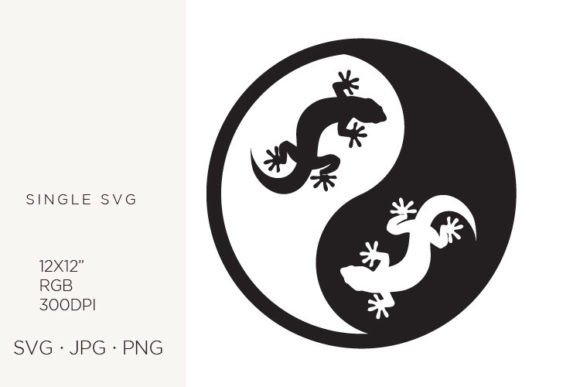
First impression? Calm, intentional, and surprisingly grounded. The yin-yang core is clean and proportionally precise—not too tight, not too loose—while the lizard wraps organically around the curve, tail curling into the dark half, head emerging from the light. It doesn’t shout; it invites pause. That matters when you’re embroidering for real people: a yoga studio owner ordering tote bags, a holistic therapist gifting embroidered pillow covers, or a small-batch maker creating mindful nursery decor. This isn’t novelty embroidery—it’s design with staying power.
Where It Shines in Real Embroidery Projects
I tested Yin Yang, Balance Symbol, Lizard as a sweatshirt embroidery piece (front left chest, 3.5" wide) and as a centered motif on a linen tea towel. On both, it held clarity without overloading stitch density. The curves stayed smooth, the negative space between lizard scales and yin-yang boundary remained legible, and the overall shape scaled down cleanly—even at 2.75". That makes it ideal for:
- Custom apparel: sweatshirts, lightweight hoodies, and structured caps (with proper stabilizer)
- Embroidered patches: works well as a sew-on or iron-on for jackets, backpacks, or aprons
- Baby embroidery: gentle enough for onesies and burp cloths, especially in soft pastel thread palettes
- Holiday or wedding gifts: pairs thoughtfully with neutral linens, ceramic mugs (for printable mockups), or handmade journals
- Etsy listings and craft fair products: feels premium but approachable—customers recognize the symbolism without needing explanation
It also holds up in digital contexts: I dropped the SVG into a mockup generator for a boutique apron listing and got immediate visual cohesion—no tweaking needed. As an Illustration asset, it bridges handcrafted warmth and graphic precision.
Where to Pause—and Test First
Like any thoughtful design, Yin Yang, Balance Symbol, Lizard has natural boundaries. Its strength lies in balance—not busyness—so avoid pushing it where detail would collapse:
- Small hoop sizes under 3": The lizard’s eye and subtle scale definition may soften or vanish. Always run a test on scrap fabric first.
- Textured or stretchy fabrics: Terry cloth, ribbed knits, or thin jersey need extra stabilizer—and possibly slight simplification of inner contours before digitizing.
- Dark or heavily patterned backgrounds: The RGB color palette gives flexibility, but preview your thread colors against black or navy fabric in grayscale mockups. Some contrast gets lost if the fill stitch density runs too low.
- Curved surfaces like baseball caps: The circular flow helps—but confirm the design fits comfortably within the front panel’s arc before committing to production.
What It Adds to Your Finished Product
This isn’t just another Graphics download. Yin Yang, Balance Symbol, Lizard elevates perceived value because it feels *designed*, not assembled. Customers notice that. A handmade product with this motif reads as intentional—like the maker paused to consider meaning, not just placement. For Etsy sellers, that translates to better reviews (“so much more than a logo”), stronger brand consistency, and repeat buyers who return for similarly thoughtful design assets.
It also builds trust. When someone orders a personalized gift—a baby’s first embroidered blanket, a therapist’s custom tote—the symbolism resonates emotionally. You’re not just stitching fabric; you’re reinforcing calm, duality, presence. That quiet professionalism shows in how cleanly the satin stitch wraps the yin-yang edge, how evenly the fill stitch renders the lizard’s body, and how gracefully the whole composition sits on the garment.
Practical Designer Notes Before You Stitch
Before using Yin Yang, Balance Symbol, Lizard in a client project or shop listing, here’s what I do—and recommend:
- Run a test stitch on scrap fabric matching your final substrate—especially if using textured, dark, or delicate material.
- Check thread color contrast in both light and dark mockups. Try matte black thread on cream linen, then heather gray on white cotton.
- Review stitch density: vector art doesn’t auto-translate to optimal embroidery. If digitizing yourself, keep fill areas open enough to avoid puckering.
- Confirm hoop size compatibility. At full 12×12 artboard scale, this is clearly meant for scaling—not direct hooping.
- Inspect fine details: the lizard’s nostril, the subtle break in the yin-yang line, and the taper of the tail tip all benefit from sharp vector edges (which Adobe Illustrator delivers).
- Test black-and-white rendering. Many commercial embroidery projects rely on single-color execution—does the shape hold?
- Verify licensing terms. Since it’s labeled “You Can use this digital graph,” confirm whether resale of finished embroidered items or redistribution of the digital file is permitted for your craft business model.
Bottom line? Yin Yang, Balance Symbol, Lizard earns its place in a working designer’s library—not as filler, but as a reliable, resonant anchor. It works for the hobbyist stitching a holiday pillow cover and the small shop owner building a cohesive line of mindful apparel. It’s balanced. It’s intentional. And in embroidery, where every stitch carries weight, that’s everything.