Disco Ball and Lizard Skeleton Graphics
As someone who’s launched over 200 digital product listings across Etsy, Creative Fabrica, and Shopify—and shipped thousands of print-on-demand items—I opened Disco Ball and Lizard Skeleton expecting either a niche gem or a visual mismatch. What I found was something more interesting: a tightly composed, vector-based illustration with strong contrast, playful irony, and unexpected commercial versatility.
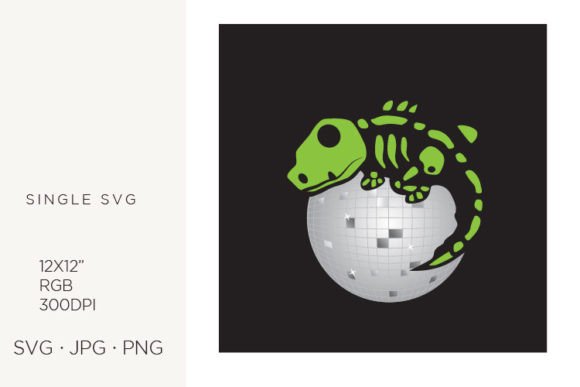
First impression? It feels simultaneously retro-futuristic and darkly whimsical—like a vintage science poster reimagined for Gen Z party decor. The disco ball reflects fragmented light; the lizard skeleton is cleanly articulated, almost anatomical, yet stylized enough to avoid clinical stiffness. It’s not cute. Not elegant. Not minimalist. It’s bold, slightly surreal, and instantly memorable—ideal for audiences drawn to alternative aesthetics: goth-adjacent crafters, indie educators, tattoo-inspired stationery sellers, and boutique apparel brands targeting festivals, pride events, or Halloween-adjacent seasons.
This isn’t background filler. Disco Ball and Lizard Skeleton commands attention—so it works best when treated as a hero graphic, not an accent. I tested it across real product categories before finalizing my shop update:
- SVG products: Clean vector paths mean crisp cuts on Cricut and Silhouette machines—especially at 4–6 inches. I ran test cuts on vinyl and heat transfer material; no jagged edges or stray anchor points.
- PNG design use: The included transparent PNG (300 dpi, 12×12") scaled beautifully for planner stickers, greeting card overlays, and Canva template elements. No haloing or anti-aliasing artifacts.
- Sublimation design: On ceramic mugs and polyester tote bags, the RGB color palette held richness without oversaturation—no need for manual CMYK conversion.
- Printable wall art: Printed at 8×10" and 11×14", it retained sharpness and tonal balance—even on matte fine-art paper.
- Digital download bundles: Paired it with coordinating geometric borders and retro typefaces in a “Night Lab” themed pack. Converted well into ZIP bundles with clear file labeling (SVG, PNG, JPG).
Where Disco Ball and Lizard Skeleton elevates product presentation is in mockup integration. I dropped it into lifestyle mockups—tote bag flat lays, framed wall art scenes, and tumbler wrap previews—and noticed immediate lift in thumbnail click-through. Its high-contrast silhouette reads clearly even at small sizes, and the reflective disco element adds subtle visual texture that avoids flatness. For Etsy listings, that translates directly to better scroll-stopping power amid crowded search results.
It also strengthens brand consistency when used intentionally—not as a standalone, but as part of a visual language. In my seasonal “Midnight Study” collection, I reused its color accents (teal, magenta, deep violet) across social media graphics, packaging labels, and blog headers. That repetition built cohesion without feeling repetitive.
But here’s where realism matters: Disco Ball and Lizard Skeleton isn’t universally flexible. Avoid using it in contexts where subtlety or precision is required:
- Don’t shrink it below 1.5" for sticker sheets—it loses skeletal detail and becomes a blobby silhouette.
- Don’t layer it densely in scrapbooking kits or digital paper packs—it overwhelms delicate patterns.
- Avoid placing it on dark backgrounds without testing first: the disco reflections can mute against black or charcoal unless you add a subtle white stroke or drop shadow.
- Don’t assume automatic cut-line readiness for complex Cricut projects—inspect the SVG in Design Space. Some inner details (e.g., individual disco facets) may need ungrouping or simplification for clean weeding.
Before listing anything, I always run four quick checks:
- Mockup test: Drop the PNG into a realistic product mockup (e.g., Redbubble t-shirt preview or Placeit mug render) and view at 100% zoom.
- Thumbnail test: Resize to 300px wide—the size many marketplace grids display—and ask: does the core idea read instantly?
- Background test: Preview on white, black, and mid-tone gray. Does contrast hold? Does transparency work as expected in PNG?
- Licensing check: Confirm the seller grants full commercial license for end products—no attribution required, no resale of raw files. This one does, which is essential for print-on-demand and digital download shops.
Font pairing matters too. I matched Disco Ball and Lizard Skeleton with three distinct type treatments across my listings: a sturdy sans serif (Inter) for t-shirt designs, a flowing script (Brittany) for invitation templates, and a bold display font (Bebas Neue) for social media banners. Each reinforced a different use case without clashing with the illustration’s personality.
File organization is non-negotiable for customer trust. I renamed all assets clearly: “DiscoBall_LizardSkeleton_SVG”, “DiscoBall_LizardSkeleton_PNG_Transparent”, “DiscoBall_LizardSkeleton_JPG_HighRes”. No cryptic names like “graphic_037”. Customers—especially Canva template sellers and Cricut users—expect clarity. They’re paying for time savings, not file archaeology.
For creative marketplace sellers, this illustration fits neatly into multiple revenue streams: as a standalone SVG design for crafters, as a premium clipart component in themed bundles, as a focal point in printable wall art collections, and as a signature graphic in branded Canva templates (e.g., “Science Party Invite Kit”). Its vector origin means infinite scalability—no pixelation on large-format prints or embroidery digitizing prep.
Bottom line? Disco Ball and Lizard Skeleton isn’t for every shop—but for sellers building intentional, audience-aligned digital product lines, it’s a smart, stylistically confident asset. It bridges novelty and usability, stands out without sacrificing professionalism, and performs reliably across physical and digital formats. If your brand leans into curiosity, contrast, and clever juxtaposition, this illustration earns its place—not as filler, but as a functional, market-tested graphic design asset.