Hammer and Axe, Vector: Handcrafted Graphics for Bold Illustrations
As a graphic designer who’s built brand identities for woodworkers, artisan toolmakers, and seasonal craft fairs over the past 12 years, I recently evaluated Hammer and Axe, Vector for a real client project: a limited-edition line of hand-forged garden tools launching this spring. The goal? A cohesive visual language that feels grounded, skilled, and quietly powerful—not rustic cliché, but authentically tactile. From the first glance, Hammer and Axe, Vector delivered a strong first impression: clean linework, confident negative space, and a subtle asymmetry that suggests human making, not machine perfection.
A Mood That Lands—Not Just a Symbol
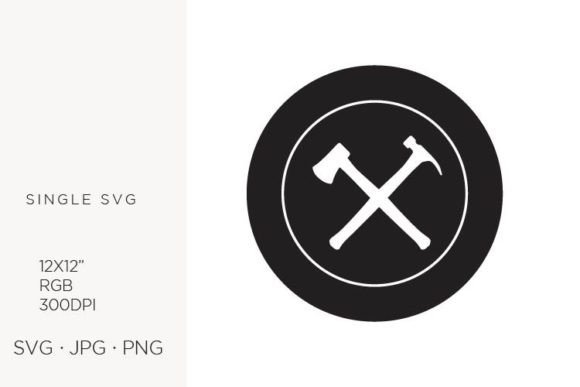
This isn’t generic clipart. The composition leans slightly forward, with the hammer head angled to imply motion and the axe blade catching imagined light—even in its minimal form. It reads as both functional and symbolic: strength without aggression, craftsmanship without pretense. That nuance makes it ideal for handmade businesses, local makers’ markets, heritage brands, or even wellness-adjacent products (think “grounding,” “resilience,” “building from scratch”). It avoids cartoonishness while staying approachable—rare for dual-tool iconography.
Where It Shines in Real Client Work
In practice, Hammer and Axe, Vector excels where authenticity and visual weight matter most:
- Product labels & packaging design: Scaled at 1.5–2.5 cm tall, it anchors jar stickers or kraft-paper tags beautifully—especially when paired with a sturdy serif or warm sans serif font.
- Merchandise & sublimation design: As an SVG logo icon - artboard size 12 x 12 resolution 300 dpi RGB color palette files formats - svg - jpg - png Files are made in a vector program - Adobe illustrator You Can use this digital graphics elem, it scales flawlessly for t-shirt design, tote bags, and ceramic mugs. On dark fabrics, the crisp edges hold up; on light backgrounds, it reads cleanly even without outlines.
- Social media graphics & Canva templates: Its balanced proportions make it highly adaptable for Instagram posts, Pinterest pins, or email headers—particularly when used as a decorative accent beside headlines or as a bullet point in branded content calendars.
- Cricut projects & printable design: The included SVG and PNG files import seamlessly into Cricut Design Space. With transparent backgrounds, it layers cleanly over textured paper scans or watercolor mockups—perfect for DIY wedding signage, workshop invitations, or Etsy product bundles.
- Editorial design & blog visuals: When placed beside editorial photography of hands at work, it reinforces narrative without competing—ideal for small business branding blogs or craft-focused newsletters.
Where to Use It Thoughtfully
Like any strong graphic design asset, Hammer and Axe, Vector has boundaries. It’s less effective in contexts demanding extreme minimalism or clinical precision—think fintech dashboards, law firm letterheads, or luxury skincare branding. Avoid placing it:
- Below 8 mm wide in print—fine detail (like the subtle taper of the axe handle) begins to blur;
- Over busy photographic backgrounds without a subtle drop shadow or solid shape behind it;
- In layouts already dense with iconography—its visual authority can overwhelm supporting elements;
- Alongside ultra-thin display fonts or delicate script fonts unless intentionally contrasted for emphasis.
Design Judgment Notes You Can’t Skip
Before locking it into a client deliverable, I always run these checks:
- Test black and white: Convert to grayscale—does the silhouette retain clarity? Yes, it does. No hidden detail vanishes.
- Check contrast on light/dark backgrounds: The SVG logo icon - artboard size 12 x 12 resolution 300 dpi RGB color palette holds up well, but I recommend verifying PNG transparency against your brand’s exact background hex values.
- Preview at scale: Drop it into a real product mockup—not just a blank artboard. Does it feel anchored, or floaty? In our garden tool mockup, it sat perfectly centered on a linen pouch label.
- Review file integrity: The SVG is fully editable in Illustrator—anchor points are clean, no stray paths. PNGs render sharp at 300 dpi, with true alpha transparency (no fringe).
- Font pairing test: It pairs strongly with Public Sans (modern utility), Playfair Display (craft heritage), and Marck Script (handmade warmth)—but avoid competing scripts with similar stroke weight.
- Confirm commercial license: This is a commercial design asset—licensed for client work, print-on-demand, and Etsy product listings. Always verify terms before bundling into a design bundle or Canva template.
Why It Earns a Spot in My Creative Toolkit
Hammer and Axe, Vector doesn’t shout—it asserts. That quiet confidence translates directly into visual trust for audiences. For small business branding, it signals capability without arrogance. For marketing visuals, it adds texture without clutter. And for digital sellers building scalable assets, its flexibility across SVG, PNG, and JPG means one purchase supports web design, social media graphics, packaging design, and printable wall art—all without licensing friction.
It’s not a trend-chasing illustration. It’s a foundational creative design element: versatile enough for seasonal campaigns, durable enough for long-term brand identity, and human enough to resonate with real people who value skill, substance, and story. Whether you’re designing for a Cricut project, a sublimation design launch, or a full-service brand refresh, Hammer and Axe, Vector earns its place—not as decoration, but as intention made visible.